Film & Television Production at JMC
JMC’s Film & TV course blends real-world experience with creative ambition. Whether you’re drawn to screenwriting, directing, editing, production design or producing, you’ll dive into hands-on projects - from short films and documentaries to music videos and multicamera productions, that not only refine your craft but also build a professional portfolio. With a focus on current industry practices and strong networks, JMC’s Film & TV course is designed to help you gain the skills and connections to launch a rewarding career. Graduating students also leave with a portfolio of diverse work to show future employers.
Why Study Film and Television at JMC
Career outcomes
JMC Film & Television graduates shape the movies, shows, and digital content we watch every day. This course lets you dive into both the creative and technical sides of screen production, with advanced electives in directing, cinematography, editing, sound, producing, music video, screenwriting, and production design to build real-world skills.
Our graduates work as Directors, Producers, Editors, Screenwriters, Cinematographers, and Content Creators, making their mark in film, TV, advertising, and digital media across the globe. Whether you’re aiming for big studio projects or independent productions, the skills you gain here open doors to diverse opportunities throughout the industry.
Who is this for?
This course is designed for individuals passionate about storytelling and the collaborative craft of screen production—whether you're drawn to creative leadership or the technical artistry behind the scenes. It suits aspiring above-the-line professionals such as directors, producers, and screenwriters who want to develop strong conceptual, narrative, and leadership skills.
At the same time, it’s ideal for those pursuing below-the-line entry-level roles like camera assistants, art department assistants, data wranglers, production runners, grips, sound assistants, and editors—the essential crew members who bring productions to life. Through hands-on experience with industry-standard equipment and workflows, you’ll collaborate on real productions, build a professional portfolio, and gain the practical knowledge needed to work across film, television, streaming, and digital content creation.
Learn from industry Experts
Lexee's Story
From JMC graduate to Film Director - discover how Lexee turned her passion for film into winning international film awards.
What you learn
You’ll explore the full spectrum of filmmaking - from concept and screenwriting to directing, cinematography, and post-production. Learn how to tell stories visually, lead production teams, and bring creative projects to life through hands-on, industry-standard practice.
What you gain
A portfolio consisting of professional short films and visual works, along with real-world production experience. You’ll graduate as a confident filmmaker with a broad skill set ready for roles in film, TV, streaming, editing and content creation.
Life at JMC
Life at JMC is about more than classes - it’s about being part of a creative community. With state-of-the-art facilities, collaborative projects, and a vibrant campus culture, students are surrounded by like-minded people who share their passion for the arts. From industry events and performances to student showcases and social activities, JMC offers an environment where creativity thrives, connections are made, and ideas come to life.
Course Structure
The Bachelor of Creative Arts (Film & Television) spans six trimesters of creative and technical exploration. You’ll begin with storytelling, camera operation, and production fundamentals before advancing into directing, cinematography, editing, and producing. You’ll work on a range of screen projects - from short films to documentaries - while refining your craft and portfolio. The course culminates in a professional final project and showreel that prepares you for entry into the film, television, and digital screen industries.
Film & Television Course Structure
Film & Television Electives
In this unit, students move beyond merely lighting a scene, to using lighting as a means to express the meaning of the scene. This will require an investigation into the aesthetics of image design, and a more in-depth technical understanding of, and the relationships between, the camera, lenses, and lighting. This unit will provide students with the opportunity to creatively analyse a script and use the camera and lighting to convey emotion, style, and narrative. This unit will be delivered in a combination of in class tutorials, creative workshops and in the studio or on location.
Prerequisite: FTP203 (Camera & Lighting 1)
This unit has been designed specifically for those students whose professional goal is to be a cinematographer. Students will be required to investigate the application of ultra-high definition digital camera systems to the creative realisation of a motion sequence to industry standard. Students will be required to experiment with the technical elements of production, integrating knowledge and skills to create a cinematic film experience. Students will need to consider their role as cinematographers and how they can use the affordances of film production tools to visually enhance a story with appropriate expression.
Prerequisites: FTP203 (Camera & Lighting 1), FTP302 (Camera & Lighting 2)
This unit expands on the knowledge and skills developed in Screenwriting 1. This unit introduces a more sophisticated range of writing tools and techniques, as well as the challenges of writing in collaboration, for an audience, to a budget. This unit will be delivered as a series of workshops designed to simulate professional screenwriting environments and projects. Key to this unit is the work students will do to develop their understanding of the market for their writing, and how to balance creativity with the cost of production (from locations to cast, art department, wardrobe, stunts and VFX/post production elements).
Prerequisite: FTP206 (Screenwriting 1)
This units builds on FTP206 Screenwriting 1 and FTP307 Screenwriting 2 by offering students the opportunity to complete an original 45-page script for the screen.
Screenwriting 3 - Long Form aims to prepare advanced students interested in writing longer scripts for the screen, with the professional skills to develop, write, take-on board professional and peer feedback and complete re-writes of an original screenplay.
This unit seeks to further enhance students’ writing skills and prepare them for a career in the screen industries by building upon the short film scripts students will have written in FTV206 Screenwriting 1 and FTV307 Screenwriting 2, along with scripts they may have written for FTV208 Production Project 1 (Documentary), FTV422 Digital Producing and FTV316 Major Project Development.
This unit’s key objectives are:
- Asset-Building. Successful students will complete this unit having written a first draft longform script which they can further develop after graduation - and to subsequently pitch to professional producers and directors… as well as submit to state funding agencies, studios or other benefactors for further drafts.
- Craft Development. This unit will give students the tools and skills to refine and enhance their writing skills, previously developed in short form, through specialist lecturer advice and feedback, peer review and re-writes.
Students will develop skills and knowledge in script writing, editing, and receiving and giving constructive feedback as part of the rigorous development process.
Students are responsible for making sure they understand all material covered in this unit outline. Students can seek clarification on any aspect they are unsure about from the lecturer or Head of Department.
Prerequisites: FTP206 (Screenwriting 1), FTP307 (Screenwriting 2)
This unit provides students with the opportunity to develop advanced theoretical and practical knowledge of key post production practices, including editing, sound production, colour grading and colour correction. Students continue to engage with a range of software on different projects to explore advanced editing, colour correction and special effects.
Prerequisites: FTP202 (Post Production 1)
It all starts - and finishes - with the Producer. The Producer is the driving force for all screen productions, setting the goals and steering the creative, financial and administrative processes. The role starts well before pre-production begins and continues (often for many years) after the final product is delivered.
This unit will build on the foundation knowledge gained in FTP201 Producing 1, to provide students with advanced producing techniques to equip them as emerging Producers upon graduation.
These new skills will include experience at applying for both development funding and production funding from state agencies - along with the essential documentation to accompany these applications (e.g., options & rights agreements, scheduling, budgets, finance plans, HOD agreements, distribution agreements and marketing plans)
Producing 2 will also explore the world of official co-productions: the countries with whom Australia has signed treaties or MOU's and examples of subsequent productions... and the "devil in the details" of making a co-production a reality.
Prerequisite: FTP201 (Producing 1)
This unit offers students the opportunity to understand the collaborative nature of creating and producing broadcast and film title designs, station identities, social media advertising elements and graphics for the screen. During this unit students develop skills and knowledge in the process involved in responding to return briefs & creating projects from pre-visualisation to effective realisation. Students also gain hands-on experience with colour grading & correction, and develop and finalise motion graphic sequences for inclusion into their own major projects, helping build a professional portfolio and showreel for prospective employers.
Prerequisite: FTP202 (Post Production 1)
This unit follows on from Major Project: Production as the students’ films enter their final phase. A student’s ability to apply conceptual knowledge and creative and technical skills will be tested through the post production processes of a major production project or slate. Processes will include the rough cut edit, fine cut, music composition, sound editing, sound design, colour grade sound mix, incorporation of credits and online delivery. Throughout the trimester, there will be some directed classes, but most weeks, students will attend scheduled post production meetings with their fellow post crew and lecturer. It is expected that this class will appeal primarily to the producer, director, editor and possibly sound designer of a Major Project Production.
Prerequisite: FTP425 (Major Project: Production)
This unit is for students who are interested in further exploring the role of the director in screen productions. The principles of mise-en-scène will be explored in depth, theoretically and practically, covering both formal, classic and informal staging techniques. Students will be given the opportunity to develop their knowledge of the director's 'tool box' which includes advanced visual story, shot construction, camera placement and movement, complex blocking, coverage styles in the classic continuity style as well as the use of subjective time, and poetic/lyrical approaches.
Further areas of study include dramatic tone, production design, sound design, narrative and performance editing, pre-visualisation and on-set workflows and methodologies. They can use these elements to develop and present their own developing directorial voice.
The unit is delivered as a series of seminars, complemented with practical workshops focusing on ideation, and interpersonal communication techniques between directors and their key collaborators, including the craft of performance.
Prerequisite: FTP211 (Directing 1)
The unit goes hand-in-hand with Major Project Production and Major Project Post Production, providing students with the opportunity to devise and collaborate on several major creative projects. These project units are designed to showcase the students’ unique skills and talents. Ideally, the production work will become each student’s “calling card” in the industry. Major projects can include a studio programme, short film, web series, television or feature film pilot or documentaries, but all productions can be no longer than 10 minutes. This unit is specifically aimed at Directors and Producers who will choose and scope out their projects; work to revise and edit numerous drafts of their script; devise a social media strategy for their project and directly specify their target audience; assign all major roles to their student production; and ultimately pitch their developed project to an industry panel.
Prerequisites: FTP203 (Camera & Lighting 1), FTP208 (Production Project: Documentary), FTP304 (Production Project: Short Film)
In this unit, students will be given an opportunity to develop their skills in the production of a music video to industry standard. Delivered as a series of workshops and studio sessions, this unit emulates real world practice, with the lecturer adopting the role of record company head.
Students will be guided through the inner-workings of the music video business – the relationships between label, management, and production company, as well learning how to write and interpret creative briefs. Students will work in collaborative teams to develop their pitch for a music video. Once green-lit, students will plan, pre produce, shoot, and post produce music videos. As part of this process, students will work with their peers in other disciplines in the making of the music video.
Design is an essential element of telling stories on the screen. In this unit, students will study the art of screen design – specifically when it comes to Production Design and Costume Design. Production Design is examined through real world examples and practical exercises. Students will evaluate and create designs in categories such as space, interiors, exteriors, light, colour and set decorating for studio sets and locations. In studying Costume Design, students learn about envisaging character, working with colours, fabrics, and other materials, and collaborating with production designers, actors, and the director. Students will also work to a brief and a budget and will look to utilise their knowledge and experiences in their student productions. This unit will be delivered as a series of tutorials, masterclasses, and workshops (including for example: Special Effects Make-Up).
This unit introduces the student to the foundation principles of acting, which provide the base from which the actor begins to build their process.
This acting foundation describes freedom and availability as core principles of the actor’s process. This approach to the work requires self-awareness to identify personal limitations or habitual behaviours and to then apply preparatory techniques to enable the actor to respond to stimulus moment to moment.
Students will undertake a range of practical preparation activities and exercises to develop these core skills, as well as developing conceptual understanding of these foundation principles and how these form the basis of the actor’s work. These foundation skills will be applied through both theatre and screen performance exercises and activities.
Digital compositing is the process of combining visual elements into cohesive still and moving images and is integral for any post-production facility. Students are introduced to key areas in compositing, moving from separating and combining still images, to working with complex transparency, camera movement and computer-generated images. These scaffolded weekly projects prepare students for a proposal and project completed in a para-professional studio environment.
Prerequisite: FTP303 (Post Production 2)
This unit introduces students to the post production principles of sound for screen and moving image. Students will focus on the use of sound as a form of creative expression and narrative structure. The unit will cover the functional aspects of sound for screen including the various delivery formats for online and platform requirements. Students will analyse the use of sound, and its emotive qualities for screen and moving image.
Prerequisite: FTP207 (Introduction to Sound Recording)
*by application only
COL401 Internship aims to provide students with an internship opportunity that has sound educational value and provides students the chance to initiate and/or develop relationships with professionals in their discipline. COL401 allows students to prepare or consolidate their know-how to work as a professional and increase their technical and creative skills base. It also allows students to explore potential areas of employment.
In this unit the National Society for Experiential Education’s definition of “internship” is used. This is internship is a carefully monitored volunteering or working experience where an individual has intentional learning goals and reflects actively on what they are learning throughout the experience. For this reason, beside the time students spend during their internship, they will also spend self-study time. They will reflect upon their awareness of applying theory to practice during their internship, practicing their ability to evaluate situations, critical thinking, and effective communication of their decision-making.
Students will also elaborate a professional plan where they explain their aspiring professional development goals and the activities that would assist them to achieve these under the guidance of their Internship Coordinator/Supervisor.
Context
At JMC Academy, students undertake a rigorous academic program of practice-based learning, into which is embedded a range of work-integrated learning activities. To complement their on-campus learning, students are also encouraged to generate their own creative work. This unit of study has been designed to formally recognise that work. Students will have access to an e-portfolio as a presentation mode for the assessable items. The unit is placed during the final study periods of the bachelor’s degree, enabling students to collect and display their best and most recent examples of their engagement with their discipline outside of their formal study.
How it works
Students are introduced to this unit during Trimester 1 and then again in successive study periods. Students must be invited by their Head of Department to enrol in this unit; a student will only be enrolled in this unit if the Head of Department is confident that the student can meet all learning outcomes. The e-portfolio JMC students will be given access to an e-portfolio platform at no cost as part of the Microsoft365 subscription. The platform provides students with a place to curate and display their extra-curricular activities for assessment in this unit. It is not the professional portfolio students could use COL401 Internship aims to provide students with an internship opportunity that has sound educational value and provides students the chance to initiate and/or develop relationships with professionals in their discipline. COL401 allows students to prepare or consolidate their know-how to work as a professional and increase their technical and creative skills base. It also allows students to explore potential areas of employment.
Careers
Film and television careers open the door to every corner of the screen industry - from directing and producing to cinematography, editing, and beyond. At JMC, you’ll learn by doing, working on real productions with industry-grade equipment, and graduate with the creative confidence and portfolio to launch your career.
Potential Career Paths
* Salaries sources from Glassdoor, Indeed, Payscale, Salaryexpert, gigexchange and Seek
Graduate spotlight
Our Film & Television Partners
Film & Television Industry Snapshot
$20.2B
The Australian screen industry’s total output sits at A$20.2 billion.2
$6.2b
The industry contributes A$6.2 billion to Australia’s GDP, of which A$5.1 billion is direct value added.2
42,000
The Australian industry employs more than 42,000 creatives.1
50%
Creative employment is growing at a rate of more than 50% higher than the rest of the workforce.1
1. ABS 2021 Census 2. Access Economics, PwC, Screen Australia
Where Our Film & Television Graduates Work
- Warner Bros.
- Universal Pictures
- Village Roadshow Pictures
- BMG
- Nine
- Network 10
- LADbible
- Stan
- Glitch Productions
- Australian Radio Network
- RIVR Media
- Ludo Studio (makers of Bluey)
- Screen Queensland
- The Post Lounge
Showcase
Film & Television Student Showcase
Film and Television students at JMC produce an exciting range of projects - from short films and documentaries to music videos and series pilots. The showcase highlights their ability to tell compelling stories through directing, cinematography, editing, and production design. It’s a behind-the-scenes look at emerging filmmakers shaping the next wave of screen content.
Student Documentary Trailer
From Fury Road to Star Wars, our students met the creative force behind Hollywood's most legendary creatures. Odd One Out is a 15-minute coming-of-age documentary profiling Adam Johansen, award-winning artist and co-founder of Odd Studios, the OSCAR & BAFTA-winning team behind some of film’s most iconic monsters. Created by our talented alumni, this beautifully crafted film is a testament to the next generation of storytellers.
Laneway Festival Work Experience
Our Film and Television students gain hands-on industry experience through work experience at world class events like Laneway Festival. From operating cameras and vision switching to supporting stage and technical operations, they play a key role in bringing the live event to life.
Connect with us
Enquire Now
Apply Now
Course Guide
Facilities
Where You'll Learn
At JMC Academy, Film & Television students work in professional studios and facilities that mirror the environments of film sets, post-production houses, and broadcast studios. From your very first week, you’ll get hands-on experience with industry-standard equipment and workflows, preparing you to step confidently into the screen industry. It’s more than a film school - it’s a creative community with multiple opportunities to enhance your practical skills, all of which put you in great stead for life after JMC.
Cinematography & Production Equipment
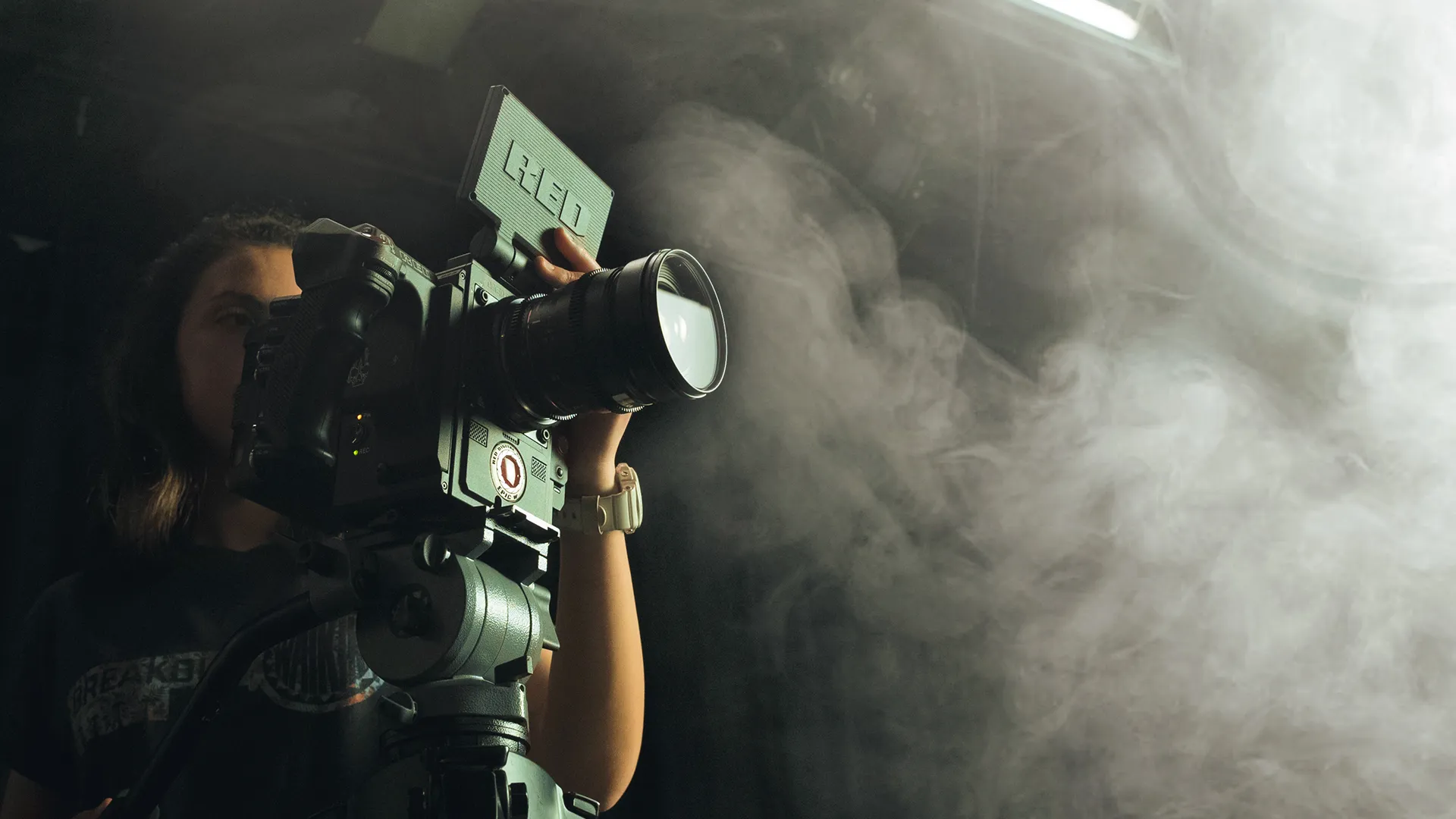
Work with professional-grade cameras and gear used by the global industry, including RED EPIC-W™ HELIUM™ 8K, Blackmagic URSA Broadcast G2, and Panasonic AG-CX350 cameras. Students also have access to a full range of lenses, lighting kits, and sound equipment through the campus loan facilities, giving you everything you need to create projects at a professional standard.
Multi-Cam Studios & Green-Screen Facilities
Step into multi-camera broadcast studios and green-screen studios to explore live production and virtual environments. These spaces allow you to experiment with different genres, collaborate with other disciplines, and gain the kind of studio experience used across television and streaming industries.
Editing, Colour & Post-Production
Refine your storytelling in our dedicated editing and colour grading suites, equipped with Avid Media Composer, Adobe Premiere Pro, After Effects, Photoshop, and DaVinci Resolve. You’ll graduate confident in the same tools used by editors, colourists, and VFX artists worldwide.
Screening & Exhibition Spaces
Experience your work in our Dolby Atmos screening space, featuring 5.1 surround sound. Here, you can present projects for your peers and special events, building confidence and gaining valuable preparation for festivals and industry screenings. Student projects can also be submitted to the annual JMC Martini Awards, where work across the JMC community is celebrated and showcased on the big screen.
Explore our campuses
Fees & How to Apply
Film & Television Production
Key Course Details
- Award: Bachelor of Creative Arts (Film and Television)
- CRICOS Code: 081192E
- Study Mode: Full-time, part-time available
- Duration: 2 years accelerated (6 trimesters)
- Delivery Mode: On-Campus
- Campus: Brisbane, Melbourne, Sydney
- Intakes: February, June, September
Application Codes
| Application Method | Course Code |
| Apply Direct | N/A |
| UAC (Sydney) | 773012 |
| VTAC (Melbourne) | 9530195432 (Domestic) |
| QTAC (Brisbane) | 070102 |
How to Apply
To apply for the Bachelor of Creative Arts (Film & Television), you can submit a direct application through the JMC Academy website (no application fees) or apply via your state's Tertiary Admissions Centre (standard QTAC/UAC/VTAC application fees apply).
Study in VIC February Intake (Year 12 Applicants): If you're currently in Year 12 in and looking to apply to JMC's Melbourne campus, you'll need to apply through VTAC for February entry.
Start Your Application
Entry Requirements
Domestic
- Academic: Completion of Year 12 or equivalent.
- ATAR: No ATAR required.
- Interview: All applicants attend an admissions interview.
- Age: Minimum 17 years old at course commencement.
See Full Domestic Entry Requirements and Alternate Entry Pathways
International
- International students must also demonstrate English language proficiency equivalent to IELTS 6.5 (Academic) with no band below 6.0. Check out our English Language Requirements for more information.
Duration
In just 2 years you can graduate with a Bachelor of Creative Arts (Film & Television) thanks to our accelerated full-time course (144 credit points). Part-time study is also available to domestic students.
International students may choose to complete the course in 3 years [CRICOS 058461C] rather than the accelerated 2 year option.
Domestic Fees
- All Film & Television Production courses are FEE-HELP eligible for domestic students.
- Tuition fees can be deferred through the Australian government FEE-HELP – no upfront payment needed if eligible.
International Fees
- Tuition fees for international students are charged per trimester, with the total program cost depending on your study load.
- A non-refundable enrolment fee also applies.
Have questions?
Our Admissions Advisors are here to help.
Important Dates
Applications for JMC Academy's Bachelor of Creative Arts (Film & Television Production) are open year-round, with three main intakes each year - February, June, and September. We recommend applying early to secure your preferred campus and start date. If you’re applying through UAC, VTAC, or QTAC, make sure to check their official key dates for application deadlines and change-of-preference periods.
See key datesRecognition of Prior Learning (RPL)
Recognition of Prior Learning (RPL) is ideal for those who have gained skills and knowledge that are equivalent to what would be learned in a JMC course, whether through formal education (including partially completed courses), work experience, or informal learning.
FAQs
We know choosing the right film course comes with lots of questions. This section brings together the answers to some of the most common queries about studying film at JMC - from entry requirements and applications, to fees, student life, and other aspects. If you don’t see your question here, our Admissions team is only a click away.
FAQs for Film & Television
This is a hands-on, two-year degree that prepares students for careers in film, television, and video production. It covers scriptwriting, directing, cinematography, editing, and producing, using real-world projects and industry gear.
The bachelor’s degree takes two years of full-time study, depending on your chosen study mode and intake.
Graduates can pursue careers as directors, producers, editors, screenwriters, cinematographers, or content creators in film, television, streaming, and digital media industries.
You’ll gain advanced skills in camera skills, narrative storytelling, production planning, directing, lighting, post-production, live broadcast, unscripted (reality TV) and pitching ideas—while creating your own original films and series.
The course is highly practical, with most learning delivered through hands-on projects, studio work, and collaborative filmmaking experiences.
Yes. You’ll have access to industry-grade cameras, lighting rigs, sound equipment, and editing software such as the RED EPIC-W™ HELIUM™ 8K used by professionals in film such as The Last Knight and Transformers as well as television production.
Yes. From your third trimester, you can tailor your studies to suit your interests, whether that’s directing, writing, cinematography, or post-production.
A portfolio is encouraged but it is not a requirement to apply for this degree. JMC welcomes passionate applicants and offers guidance if you’re just starting out with film or creative work.
Yes. Students are supported to seek internships or industry placements during their studies to build professional networks and real-world experience.
This course is available at JMC Academy campuses in Sydney, Melbourne, and Brisbane, with intakes in February and June.
No, you do not need to provide any samples of work to be eligible. However, you are welcome to provide samples of work. Any scripts you’ve written, youtube clips, short films, story boards you’ve drawn, visual and written ideas for films or tv shows, and any technical experience you may have had either in school, via extracurricular activities, work experience or volunteer work.
Absolutely. You do not need to have had any experience with film equipment as we cater to all levels of experience.
Our courses are hands on and practical. Students are required to attend classes to receive ongoing mentorship, learn new skills and work with the equipment provided. We do encourage our students to use online study resources, however our courses would not be as immersive as they are without the practical component.
Yes. The JMC Academy is registered and regulated by the Tertiary Education Quality and Standards Agency (TEQSA) which is Australia’s independent national regulator of the higher education sector, both public and private.
You will not need to purchase your own computer or any film gear as we have fully equipped editing suites and an equipment loan service with quality mics, lighting, cameras and a myriad of accessories available for student use.
JMC Academy is broadly recognised and accredited:
- Registered Higher Education Provider.
- Accredited by the Tertiary Education Quality and Standards Agency (TEQSA)
- Registered on the Commonwealth Register of Institutions and Courses for Overseas Students (CRICOS).
-
Regulated by the Australian Skills Quality Authority (ASQA).
-
Member of the Independent Tertiary Education Council Australia (ITECA).
- Nationally recognised within the Australian Qualifications Framework.
Our strong industry links also ensure that JMC Academy qualifications are recognised within the creative industries.
Although you may want to be a film maker, it is important to have a wide range of skills when entering the industry. You will still learn about film making in great detail, however this course will provide you with a greater range of career options upon graduation. The skills learnt may be applied to film as well as television production.
You will do a range of assessments that will demonstrate your understanding, including short film making, documentaries, television commercials, music videos, live broadcasts and multi-cam, pitches and presentations, sound recording, film analysis and screenplays. At the end of the Bachelor there is project based work where you'll be able to choose your main assessment, which could be any of the above.
You'll start learning the proper way to handle the film gear in your first Trimester. Students are then assessed on their competency for handling the equipment. Once this is undertaken, students are able to loan cameras and equipment suitable for their on campus or on location shoots, projects and assessments.